

The AI infrastructure trade is quietly moving one layer deeper. Traders spent the last year obsessing over GPUs, memory and grid equipment, but the next bottleneck is increasingly heat. If racks get denser and power loads keep rising, cooling stops being a background utility expense and starts becoming a hard capacity constraint. That is why this theme is starting to matter across U.S. industrials, Japanese HVAC names, Korean electronics groups and Europe-facing building-tech suppliers at the same time.
The U.S. market signal is already visible. Reuters reported on May 6 that Johnson Controls raised its annual profit forecast because demand for data-center thermal management and cooling solutions is accelerating. Then on June 2, ZutaCore announced a $100 million-plus Series C round backed by Carrier Ventures, Samsung Ventures and Mitsubishi Electric, which matters because venture money usually chases real pain points, not finished categories. When public-market earnings language and private-market capital are leaning the same way, I pay attention.
Japan and Europe are giving the story industrial shape. Panasonic said on March 4 that it had started taking European orders for liquid-cooling CDUs and free-cooling chillers aimed at generative-AI data centers, explicitly arguing that air cooling alone is no longer enough for hyperscalers and colocation sites. Daikin has also been pushing deeper into this lane, from its May data-center-cooling partnership with Delta to its June Datacloud messaging around tougher European efficiency rules. That combination suggests cooling is no longer a niche add-on. It is becoming part of the core capex stack.
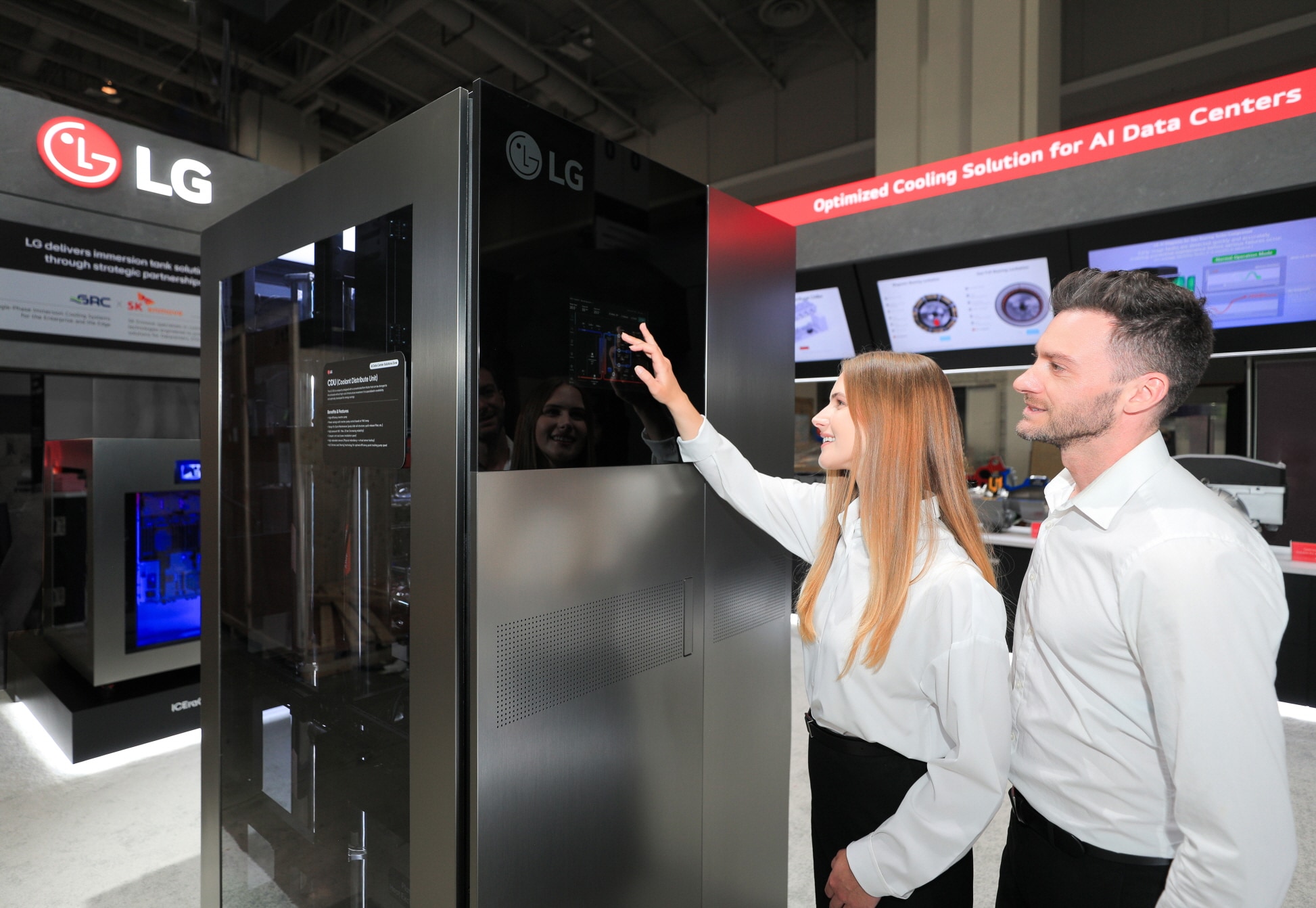
Korea is not sitting outside the trade either. LG used Data Center World 2026 in Washington to show direct-to-chip cooling hardware and a 1.4 MW CDU, while Samsung used MCE 2026 in Milan to emphasize FlaktGroup’s role in larger commercial and data-center cooling applications. Even the public conversation is shifting. A June 4 discussion on Reddit’s datacenter forum framed liquid cooling as something that is moving from special case to default path for newer hyperscale GPU deployments. Retail message boards are not proof, but they are useful for seeing when an engineering constraint starts becoming common market language.
My view is that liquid cooling is becoming the next picks-and-shovels layer of the AI buildout, but it should not be traded as a cartoonishly simple “AI up, cooling up” theme. The winners are likely to be companies with credible system integration, installed customer relationships, service capability and enough manufacturing discipline to deliver at scale. The risk is that investors crowd into anything with a thermal label and ignore the difference between demonstration hardware and repeatable margin-bearing deployment. Still, the cross-market message is pretty clear: heat management is being repriced from back-office plumbing into strategic infrastructure.
Risk notice: This article is for market commentary only, not personalized investment advice. AI infrastructure, industrial, HVAC and semiconductor-adjacent names can be volatile and may react sharply to capex cycles, valuation compression, policy changes, project delays, power prices and technology shifts. Traders can lose money quickly.
Sources:
1. Reuters via MarketScreener on Johnson Controls raising guidance on data-center cooling demand (May 6, 2026): https://www.marketscreener.com/news/johnson-controls-raises-annual-profit-forecast-on-data-center-cooling-demand-ce7f58ddd08bf421
2. Panasonic press release on liquid cooling systems for generative AI data centers in Europe (March 4, 2026): https://news.panasonic.com/global/press/en260304-2
3. LG Electronics on AI data center cooling solutions at Data Center World 2026 (April 21, 2026): https://www.lg.com/global/newsroom/news/eco-solution/lg-electronics-showcases-ai-data-center-cooling-solutions-at-data-center-world-2026/
4. Samsung on expanded HVAC portfolio and FlaktGroup at MCE 2026 (March 24, 2026): https://news.samsung.com/global/samsung-showcases-expanded-hvac-portfolio-at-mce-2026
5. ZutaCore funding round backed by Samsung Ventures, Carrier Ventures and Mitsubishi Electric (June 2, 2026): https://blog.zutacore.com/press-releases/zutacore-100m-series-c-funding-ai-data-center-cooling
6. Daikin Applied Europe on AI-driven data centers and tighter European efficiency rules at Datacloud 2026 (June 2-4, 2026): https://blog.daikinapplied.eu/news-center/ai-driven-data-centers-daikins-response-at-datacloud-2026
7. Reddit datacenter discussion on liquid cooling becoming standard for newer hyperscale deployments (June 4, 2026): https://www.reddit.com/r/datacenter/comments/1twueft/with_rack_densities_soaring_is_liquid_cooling/
原创文章,作者:financial transaction,如若转载,请注明出处:https://www.fanbi.net/archives/294

