
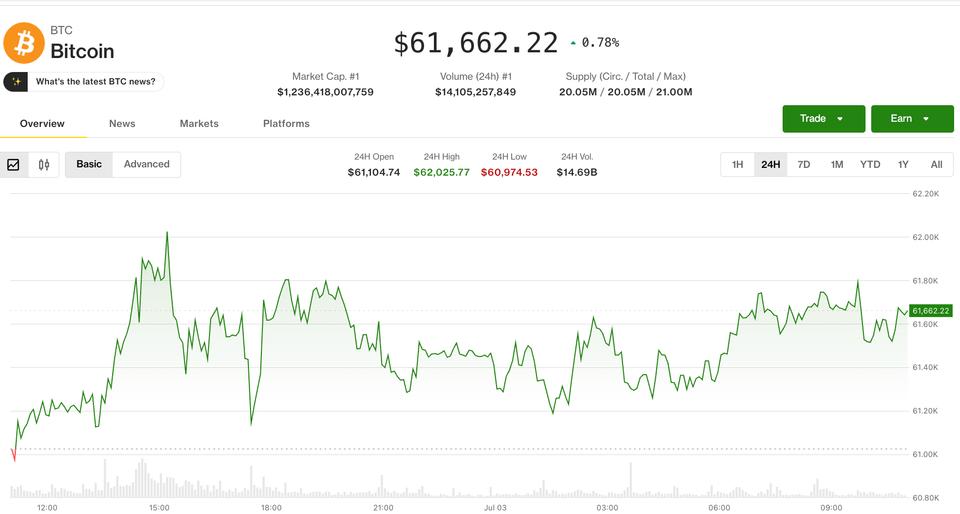
The weekend hotspot is not simply that bitcoin is green again. The interesting part is the overlap between crypto leverage, U.S. rate expectations and the wobble in AI-semiconductor leadership. Bitcoin was recently around $62,700, Ether near $1,625 and Solana near $78, but the price board alone hides the real argument: is this a durable risk reset, or just short-covering after a crowded downside trade?
CoinDesk reported that bitcoin recovered to about $61,600 on July 3 after touching roughly $57,750 earlier in the week. The same report said Ether had risen for a third straight day, with 24-hour crypto futures liquidations totaling about $417 million and Ether accounting for roughly $160.8 million of that. Solana was also one of the leaders among majors, up more than 17% on the week in CoinDesk’s market snapshot.
The ETF tape improved, but only from a weak base. CoinDesk said U.S.-listed spot Bitcoin ETFs took in $221.7 million on Thursday, the strongest daily inflow in two months and the end of a 10-day outflow streak. Fidelity’s FBTC led with nearly $166 million, while BlackRock’s IBIT still saw an outflow. That is why the flow signal is useful but not decisive: one positive day does not erase the prior $2.73 billion outflow run or the roughly $5.4 billion year-to-date net outflow noted in the report.
The options market is even more skeptical. CoinDesk’s Daybook said BTC and ETH puts on Deribit were still trading at a premium to calls, with bitcoin’s one-week 25-delta put-call skew around 16%. That is lower than the roughly 25% seen 10 days earlier, but it still says traders are paying for downside insurance. A large BTC call-condor flow around the July 17 expiry also pointed more toward a $66,000-$68,000 range trade than a full-blooded breakout thesis.
The cross-market link is the AI trade. AP reported that after the Dow set another record, Asia and Europe were mixed while U.S. markets were shut for the Independence Day holiday. South Korea’s KOSPI rebounded 5.8% after a near-8% drop, Samsung Electronics rose 8.2%, SK Hynix jumped 10.9%, and Japan’s Nikkei 225 advanced 1.5% with Kioxia up 9.2%. At the same time, the prior U.S. session had a Dow record while the Nasdaq fell as some chip and AI names remained under pressure.
My view: this is a relief rally with better internals than last week’s panic, but it is still not a clean trend reversal. The bullish case is that softer U.S. labor data lowered rate-hike risk, ETFs finally stopped bleeding for a day, and ETH/SOL funding shows traders are willing to re-lever. The caution case is that options skew, thin holiday liquidity and unstable semiconductor leadership all argue against treating one rebound as a new bull phase.
For traders, the watch list is tight: BTC above the mid-$60,000s without a new ETF outflow wave, ETH/BTC reclaiming its 100-day average, SOL holding its weekly breakout, Nasdaq 100 futures stabilizing after the chip wobble, and Korean/Japanese semiconductor shares avoiding another air pocket. If those signals line up, crypto beta can extend. If not, the market may discover that short-covering is fuel, not a foundation.
Sources
CoinDesk: Crypto bulls on firmer footing as U.S. rate-hike risk recedes
CoinDesk Daybook: Bitcoin and Ether traders are not fully buying the bounce
CoinDesk: Bitcoin ETFs see $221.7 million inflow
Associated Press: World shares mixed after Dow record and AI-stock volatility
Risk notice: This article is market commentary only, not personal investment advice. Crypto perpetuals, options, leveraged tokens, stock-index futures and semiconductor shares can move sharply when liquidity is thin and positioning is crowded.
原创文章,作者:financial transaction,如若转载,请注明出处:https://www.fanbi.net/archives/815