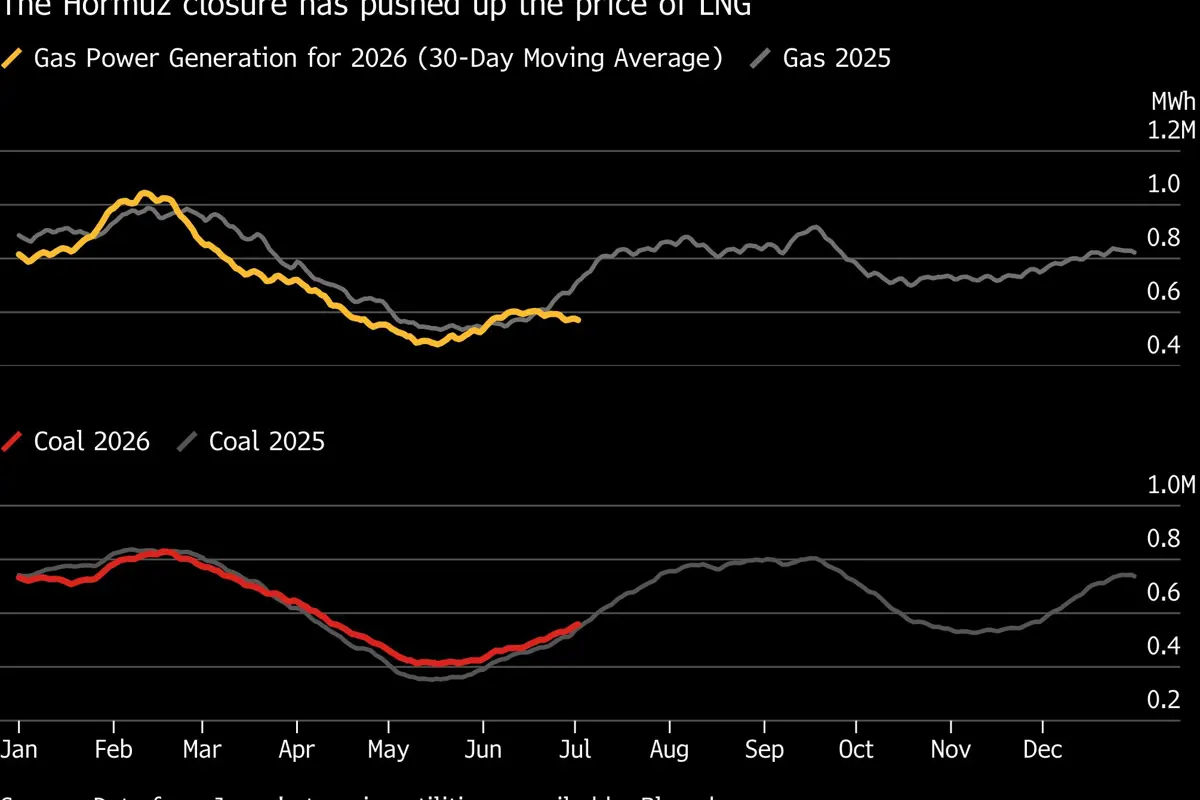


The cleaner market story this hour is not another simple oil-price headline. It is the second-round effect: expensive LNG is pushing Northeast Asia into fuel switching, policy relief and cross-benchmark arbitrage. For traders, that links JKM LNG, European TTF gas, Henry Hub, Australian coal, utility equities, shipping and inflation-sensitive FX into one tradeable map.
Bloomberg, carried by Energy Connects, reported that Japan generated about 17.3 terawatt hours of power from gas in June, down 16% from a year earlier, while coal generation rose 4.6% across the country’s nine largest utilities. OilPrice summarized the same pressure point: Japan’s LNG imports in the March-to-June period were down about 7% year on year as spot LNG stayed costly after the Strait of Hormuz disruption.
The spread explains the behavior. Global LNG Hub, citing JOGMEC, said Northeast Asian JKM for August delivery fell to the low-$15s per MMBtu by June 26, while European TTF was around $13.6 and Henry Hub was near $3.2. Those prices are lower than the panic highs, but they still leave Asia paying a very large premium to U.S. gas. OilPrice also cited Reuters data showing Asian spot gas averaged $17.33 per MMBtu in June versus $13.19 in Europe, pulling more U.S. LNG cargoes toward Asia.
Korea is treating the same shock as an inflation problem. Yonhap reported that South Korea will apply zero tariff rates on LNG and LPG within quotas in the second half of 2026 to stabilize utility and transport costs. Earlier regional reports also highlighted Korea-Japan cooperation on LNG and crude supply security, including information sharing and diversification away from Middle East dependence. That matters because policy cushions can change how energy costs flow into CPI, refiner margins and won-yen risk.
My view: this is not a bullish coal story by itself and not a bearish LNG story by itself. It is a volatility-transfer story. When Japan burns less gas and more coal, the pressure does not vanish; it migrates into coal procurement, emissions costs, shipping, utility dispatch margins and regional power prices. When Korea cuts tariffs, the pressure moves from households toward fiscal policy and import volumes. When U.S. LNG cargoes chase Asian premiums, Henry Hub can look calm while global LNG remains tight.
The practical watch list is narrow. If JKM keeps easing while Japan’s inventories rebuild, the panic premium fades and coal substitution loses urgency. If JKM holds above TTF and Henry Hub while Asian heat demand rises, traders should expect renewed attention on LNG shippers, coal exporters, Japanese utilities, Korean gas costs and European storage. The risk is that the market confuses lower headline oil prices with normalized energy supply. The fuel mix is saying normalization is still incomplete.
Sources
Energy Connects / Bloomberg: Japan cuts gas in favor of coal as Hormuz disruption chokes LNG
OilPrice: Japan’s LNG imports fall 7% as utilities chase cheaper coal
Global LNG Hub: JKM, TTF and Henry Hub weekly update, 29 June 2026
Yonhap: South Korea to apply zero tariffs on LNG and LPG under quota scheme
U.S. EIA Short-Term Energy Outlook
Risk notice: This article is market commentary only, not personal investment advice. LNG, natural gas futures, coal, utility shares, energy equities, FX and leveraged products can move sharply when geopolitics, weather, inventories and policy relief change at the same time.
原创文章,作者:financial transaction,如若转载,请注明出处:https://www.fanbi.net/archives/812