
Traders are starting to talk about advanced air mobility in a different tone. A year ago the conversation was mostly about futuristic concept videos and whether electric air taxis would ever leave the demo stage. In June 2026, the more serious discussion is about certification gates, route approvals, airport access, and who can survive the capital burn long enough to turn a prototype into a regulated transport business.
The U.S. remains the clearest price-discovery venue because listed names such as Joby Aviation and Archer Aviation give the market liquid proxies. Joby said on March 11 that its first FAA-conforming aircraft had begun flight testing for Type Inspection Authorization, a meaningful step because it moves the story from promotional language toward regulator-observed evidence. Archer said on May 11 that it expects initial U.S. operations this year under the White House-backed eVTOL Integration Pilot Program and highlighted progress in FAA certification, flight testing, and airport operations. The FAA itself made the mood shift even clearer in March when it formally rolled out the eIPP framework and named partners for early operations. That combination matters: traders are no longer just buying an idea, they are trying to price a timetable.
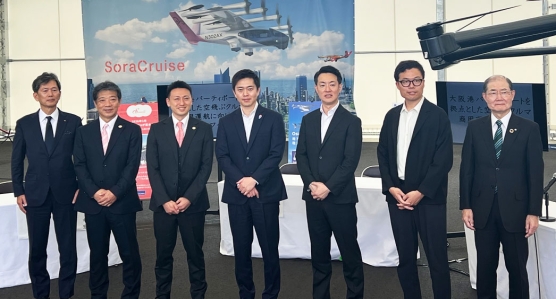
Japan adds a different signal. Marubeni’s May 8 announcement with Osaka Prefecture and Osaka City was not a flashy aircraft reveal. It was a commercialization document about vertiports, public acceptance, routes, and business feasibility in the Osaka-Kansai area. That is exactly why the market should care. Japan often turns speculative mobility themes into execution themes by forcing them through municipal planning, operating discipline, and real customer flows. If the trade was only about aircraft makers, it would still look fragile. When trading houses and local governments start mapping operations, the ecosystem becomes more believable.
Korea’s angle is industrial rather than purely financial. Hyundai Motor Group and Korea Aerospace Industries said on May 10 that they would jointly develop future air mobility solutions, with Supernal and KAI working on aircraft development and Hyundai bringing electrified aviation powertrains and large-scale manufacturing know-how. That makes Korea important because it suggests the eVTOL story may end up rewarding supply-chain depth and manufacturing discipline, not just whoever wins the most headlines on social media. In other words, this could become an aerospace-industrial trade before it becomes a mass consumer transport trade.
Europe is still the least exciting tape for short-term speculation, but it may be the most important region for credibility. EASA’s 2026 air-mobility rulemaking and continuing-airworthiness decisions show that Europe is pushing the rulebook forward even before a full commercial boom exists. That is not sexy, but it is market-relevant. The winners in this theme probably need three things at the same time: a regulator willing to define the path, local infrastructure owners willing to host operations, and enough cash to survive years of compliance work. Europe is signaling that the regulatory path is becoming less vague, which lowers one of the biggest historical discounts on the sector.
My cautious view is that advanced air mobility is no longer a pure fantasy trade, but it is also not ready to be valued like mainstream aviation. The market is right to reward certification progress and infrastructure partnerships more than glossy design updates. The risk is that investors may still be too eager to extrapolate every milestone into near-term passenger revenue. This looks more like a long build-out cycle with sharp sentiment swings than a straight-line growth story. For traders, that usually means the better signal is not hype volume but whether each company keeps converting announcements into regulatory, manufacturing, and route-level evidence.
Risk notice: This article is for market commentary only, not investment advice. Advanced air mobility names can be highly volatile, pre-profit, and sensitive to regulation, funding conditions, safety reviews, and headline risk.
Sources:
Joby Aviation: First FAA-conforming aircraft takes flight
Archer Aviation: Q1 2026 results and FAA progress
FAA: eVTOL Integration Pilot Program overview
Marubeni: Osaka advanced air mobility commercialization initiative
Hyundai Motor Group and KAI future air mobility agreement
EASA: Drones and air mobility rulemaking updates
Reddit discussion: market rotation back into eVTOL names
原创文章,作者:financial transaction,如若转载,请注明出处:https://www.fanbi.net/archives/315