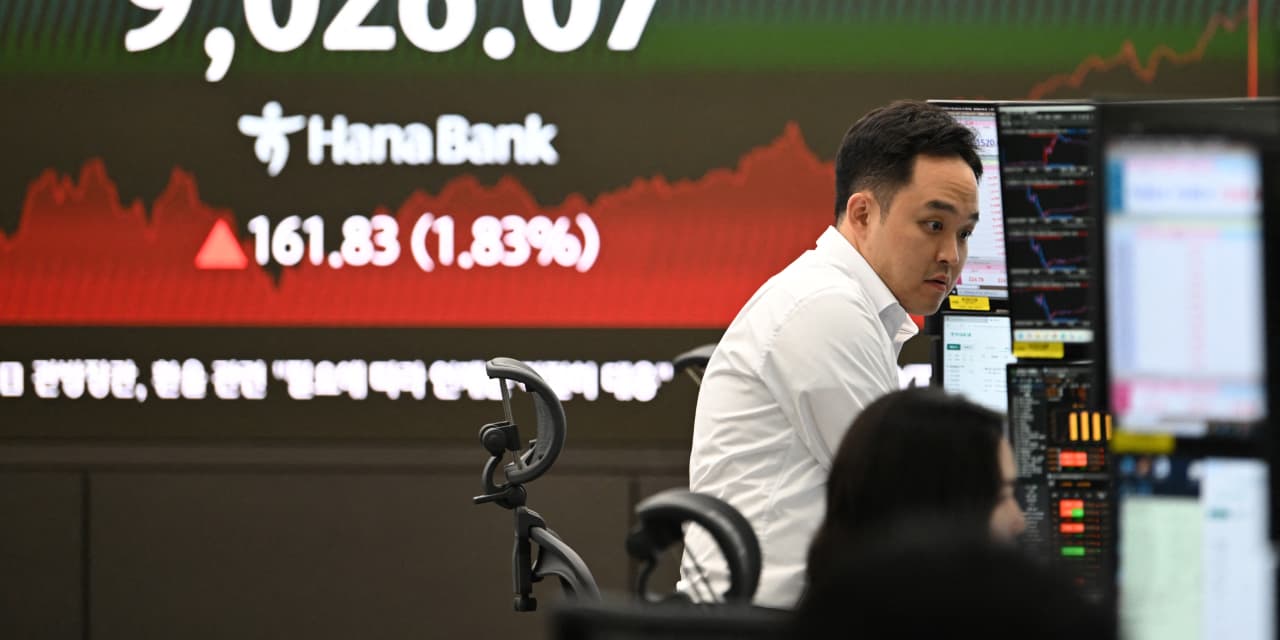
South Korea has delivered one of the sharpest reminders of 2026: a hot market can become a risk-control problem before the long-term story changes. MarketWatch reported that the KOSPI entered technical bear-market territory on July 8 after a steep fall from its June high, with semiconductor heavyweights and memory-chip enthusiasm at the center of the reversal.
The index had surged earlier in the year, supported by AI-infrastructure demand, retail leverage and strong expectations for companies such as Samsung Electronics and SK Hynix. That made the later decline more important for traders than a normal pullback. When one theme dominates an index, a correction in that theme can look like a broad market event even if earnings expectations remain respectable.
For stock-index and ETF traders, the lesson is not simply to avoid Korean equities or chip stocks. The lesson is to measure position crowding. If an index’s performance depends heavily on a small set of semiconductor names, stop levels, margin usage and overnight exposure should be sized around that concentration instead of the headline index label.
There is also a cross-market read-through. Weakness in Korea’s memory leaders can pressure global semiconductor ETFs, Nasdaq breadth and AI-infrastructure credit sentiment. A trader watching U.S. futures should therefore compare KOSPI moves with SOX, Micron, Nvidia, DRAM pricing headlines and foreign-investor flows rather than treating Asia as a separate session.
The bear-market label can exaggerate fear, but it is still useful. It forces a question: is the decline mainly profit-taking after a parabolic move, or is it a sign that financing, supply and earnings expectations are changing? Until that distinction is clearer, leverage should be reduced before trying to pick a bottom.
Sources: MarketWatch KOSPI bear-market analysis; MarketWatch South Korean shares selloff report; MarketWatch KOSPI index page.
Risk notice: This article is for education only and is not a recommendation to trade Korean equities, semiconductor stocks, ETFs or futures. Concentrated and leveraged markets can gap beyond stop levels.
原创文章,作者:financial transaction,如若转载,请注明出处:https://www.fanbi.net/archives/1599