
Perpetual futures look simple because they trade like spot pairs and have no fixed expiry. The hidden cost is that the contract needs a mechanism to stay close to the underlying spot market. That mechanism is the funding rate, and it can quietly change the economics of a leveraged trade.
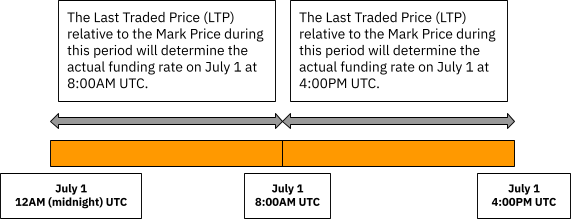
Before opening a position, start with the funding display on the futures screen. Bybit explains that funding rates can fluctuate in real time before the next funding timestamp. A positive rate generally means longs pay shorts; a negative rate generally means shorts pay longs. The payment is not a trading fee paid to the platform, but a transfer between opposite sides of the contract.
Second, check mark price, not only last traded price. Bybit says mark price is used for liquidation triggers and unrealized PnL measurement. That matters because a trader can be liquidated by mark-price movement even when the last traded price on the screen looks less dramatic. If your stop, liquidation level and mark price are too close together, the position is not sized conservatively.
Third, look at whether the exchange is changing its market-data methodology. Bitget announced July 2026 upgrades to index-price and mark-price services, including faster calculation frequency, and a separate optimization to funding-rate calculation methodology. Such updates are not trading signals by themselves, but they remind traders that contract pricing depends on exchange rules, index inputs and premium-index logic.
A simple checklist: identify the next funding time; estimate the funding cost if you hold through it; compare mark price with last price and index price; choose isolated or cross margin deliberately; place the invalidation level before entering; and reduce size when funding is extreme or the basis looks unstable. For beginners, avoiding crowded leverage is often more important than predicting the next candle.
Sources: Bybit funding-rate guide; Bybit mark-price guide; Bitget mark-price and index-price upgrade notice; Bitget funding-rate methodology notice.
Risk notice: Futures and perpetual swaps use leverage and can liquidate margin quickly. This guide is educational and is not investment advice or official customer support.
原创文章,作者:financial transaction,如若转载,请注明出处:https://www.fanbi.net/archives/1002