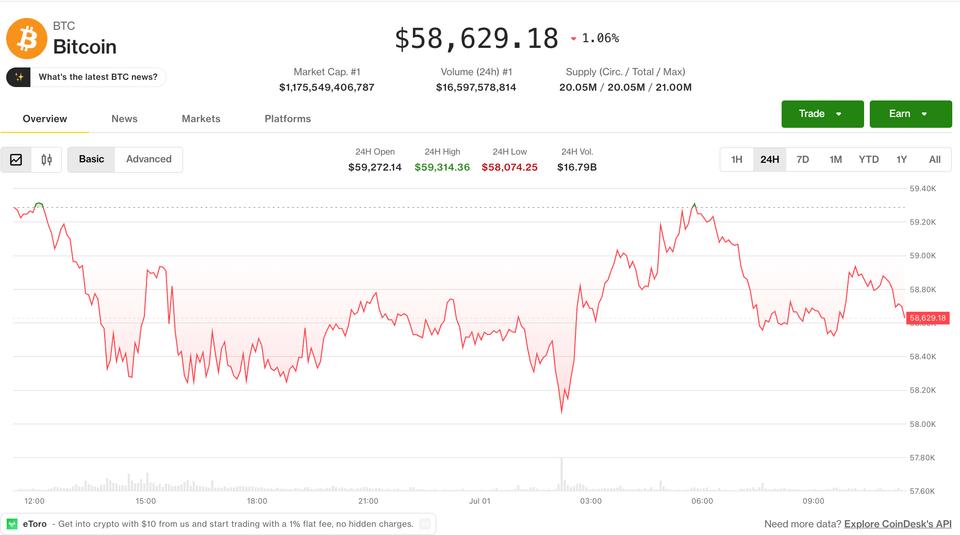

A crypto bounce is not the same thing as a clean recovery. CoinDesk’s July 3 Daybook noted that bitcoin and ether traders were not fully buying the rebound, with defensive options positioning easing but not disappearing. A separate July 1 CoinDesk report said bitcoin options traders had loaded up on $50,000 puts while gold futures were flashing their own caution signal.
For active traders, the lesson is not to memorize one options headline. The useful workflow is to compare four signals: spot price, options hedging, perpetual funding, and open interest. If price rises while put demand fades, funding stays moderate, and open interest grows slowly, the market is usually healthier. If price rises while traders keep buying downside protection and funding turns expensive, the rally may be running on fragile leverage.
Funding rates are the first check for perpetual traders. Positive funding means longs are usually paying shorts; very high positive funding can show crowded bullish leverage. Negative funding can show stress or heavy short positioning, but it can also create squeeze risk if spot demand returns. CoinGlass funding-rate pages are useful because they let traders compare BTC and ETH across venues instead of relying on one exchange screen.
Liquidations are the second check. A price move with limited liquidations may be a normal repricing. A move with a large one-sided liquidation wave is different: it can clear leverage quickly, but it can also produce a temporary bounce that fades once forced buying or forced selling ends. CoinGlass liquidation dashboards help identify whether longs or shorts are being cleaned out.
Open interest is the third check. Rising price plus rising open interest can mean new risk is entering the market; rising price plus falling open interest can mean shorts are closing. Neither is automatically bullish or bearish. The interpretation depends on whether spot volume and ETF or stablecoin flows support the move.
A practical rule: before opening a futures or perpetual position, write down whether the trade is based on spot demand, a short squeeze, a funding mean reversion, or a volatility hedge. If you cannot name the mechanism, reduce size. In choppy markets, a smaller position with a clear invalidation level often beats a larger position justified only by a green candle.
Risk notice: This article is educational market commentary, not investment advice. Futures, options and perpetual swaps involve leverage, funding costs, forced liquidation risk, and rapid mark-price movement. Use stop logic, margin buffers and position sizing that fit your own risk tolerance.
Sources: CoinDesk on cautious BTC and ETH options positioning; CoinDesk on $50,000 BTC puts and derivatives caution; CoinGlass funding-rate dashboard; CoinGlass liquidation dashboard.
原创文章,作者:financial transaction,如若转载,请注明出处:https://www.fanbi.net/archives/872