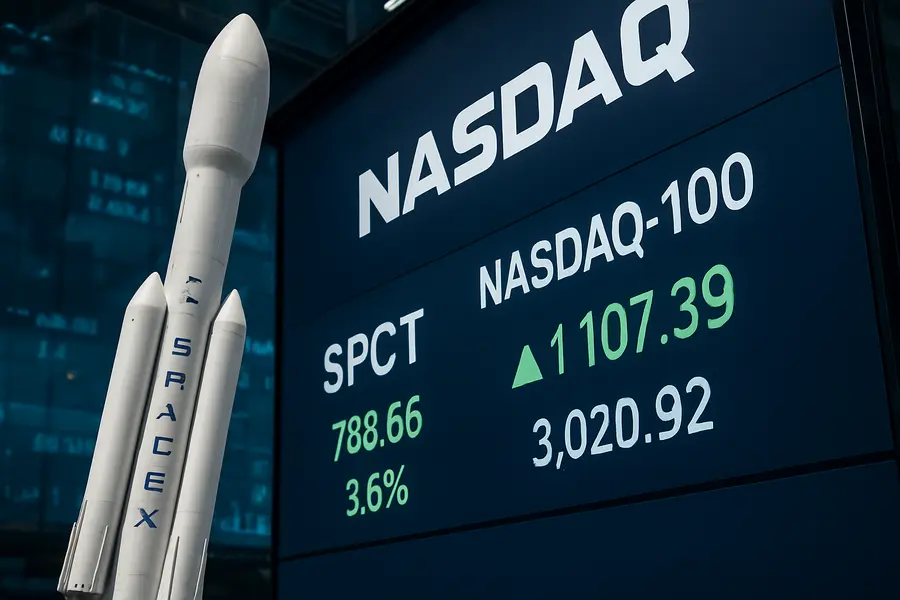
SpaceX’s addition to the Nasdaq-100 has become one of the more important U.S. equity-index stories of the day. Reuters, carried by Investing.com, reported that the company is joining the benchmark only 15 days after its June 12 market debut, with J.P. Morgan estimating about $4.3 billion of potential passive inflows tied to the index change. The move follows Nasdaq’s fast-entry framework for newly listed mega-cap companies.
For traders, the first issue is mechanics. Funds and ETFs that track the Nasdaq-100, including QQQ-style products, need to align with the benchmark. That can create forced demand around the effective date. It can also shift weights inside the index, which matters for Nasdaq futures, growth-factor baskets and options hedges that reference the same benchmark.
The second issue is not to confuse passive demand with fundamental confirmation. Fast inclusion may improve liquidity and visibility, but it does not answer questions about revenue durability, launch cadence, satellite economics, cash flow, valuation or public-float constraints. A low-float, high-valuation name can move sharply if index demand meets limited supply, and then reverse when event-driven buyers finish.
A disciplined trade plan separates three layers: the event window around index inclusion, the benchmark effect on ETFs and futures, and the longer-term company thesis. Short-term traders may watch volume, opening imbalance, implied volatility and QQQ relative performance. Long-term investors should avoid treating index entry as a substitute for financial analysis.
Sources: Reuters via Investing.com; Nasdaq fast-entry rule discussion.
Risk notice: This article is for education only. Index-inclusion trades can reverse quickly, and ETF exposure does not remove single-stock, valuation, liquidity or volatility risk.
原创文章,作者:financial transaction,如若转载,请注明出处:https://www.fanbi.net/archives/1274