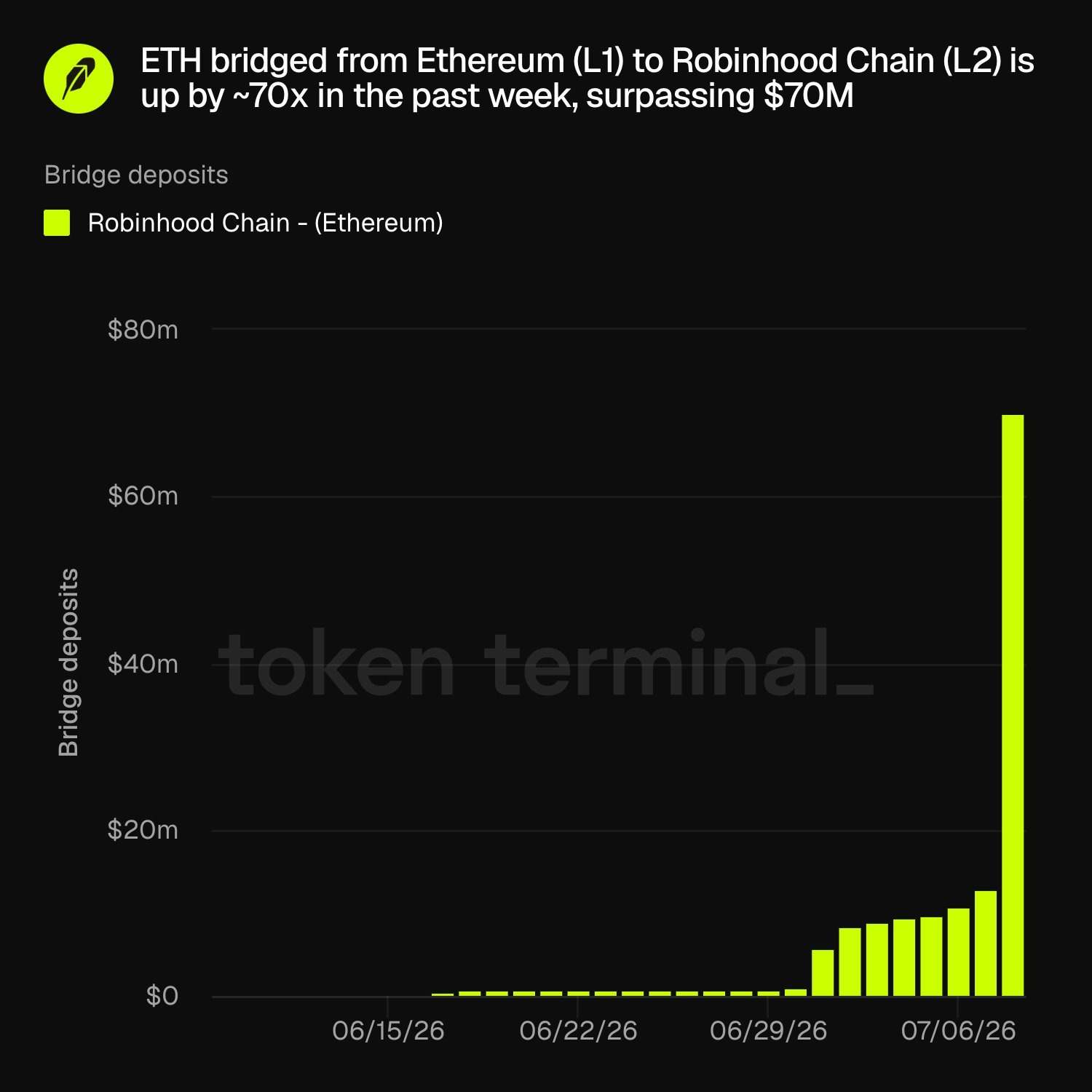
Robinhood Chain moved quickly from launch headline to live-market signal. Cointelegraph reported that more than $70 million of ETH had been bridged from Ethereum mainnet to the new Robinhood layer-2 in its first week, citing Token Terminal data. Robinhood’s own launch materials describe the chain as an AI-native, real-world-asset-focused L2 with integrations around stock tokens and onchain finance.
For traders, the number matters less as a simple bullish headline than as a test of early liquidity. A new L2 can create incremental ETH gas demand, more venues for tokenized-asset activity and new arbitrage routes, but it can also concentrate risk in bridges, wrapped assets, sequencer operations and incentive-driven flows that may reverse quickly.
The practical checklist is straightforward: monitor bridged ETH growth, app-user activity, Uniswap or other DEX depth on the chain, withdrawal paths back to Ethereum, and whether tokenized stock or RWA products are available in your jurisdiction. Early network growth is constructive only if liquidity remains usable when volatility rises.
A cautious market view is appropriate. Robinhood brings distribution, but new chains often look strongest during launch week. Traders should separate durable usage from a one-time migration spike and avoid treating bridged TVL as the same thing as risk-free demand.
Risk notice: Crypto assets, bridges, layer-2 networks and tokenized products can fail or lose liquidity. This article is market education, not investment advice.
Sources
- Cointelegraph daily crypto update
- Robinhood Chain official launch newsroom
- Robinhood Chain product page
原创文章,作者:financial transaction,如若转载,请注明出处:https://www.fanbi.net/archives/2086